Prom 2027 Preseason Guide:
How to Shop, Size & Prepare
A 32-minute deep dive into the mechanics of formalwear — designer sizing, measurements, silhouettes, closures, returns and alterations — recorded for students and parents preparing early for Prom 2027.
Before the Season Begins
Prom 2027 is still months away — and that is exactly the point. This episode of Heather’s StyleCast was recorded for the quiet stretch before peak prom-shopping season, when students and parents can learn how the process actually works without a deadline breathing down their necks. There is no urgency here; there is a manual, and this is it.
The conversation walks through the parts of formalwear shopping that surprise almost every first-time buyer. Designer sizing does not behave like everyday street sizing, and two designers can cut the same numbered size two inches apart at the waist — which is why each designer’s own size chart, read against carefully taken bust, waist and hip measurements, is the only reliable guide. The hosts unpack how silhouettes change which measurement matters most: a fitted gown lives and dies by the hip measurement, while an A-line frees you to focus on bust and waist. They contrast corset backs, which allow micro-adjustments, with zipper backs, which demand precision — and explain what that means for ordering.
From there the discussion turns practical: how designer-fulfilled online orders and backorder windows really work, why the online return window is short and structured, how final-sale merchandise differs, when to plan alterations, what to bring to a fitting, and how to budget for the gown and the tailoring that makes it yours. Press play, take notes, and start the season ahead of it.
Silhouettes from the Episode
The episode explains how your silhouette decides which measurement leads. These sketches illustrate the shapes discussed — from fitted gowns that follow the hip to A-lines that release from the waist.
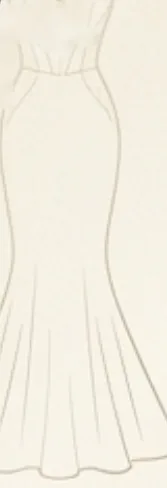 Fitted & Mermaid
Hip measurement leads
Fitted & Mermaid
Hip measurement leads
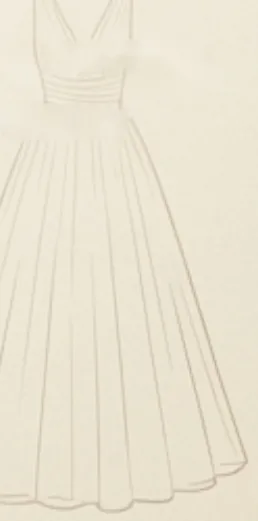 A-Line
Bust & waist lead
A-Line
Bust & waist lead
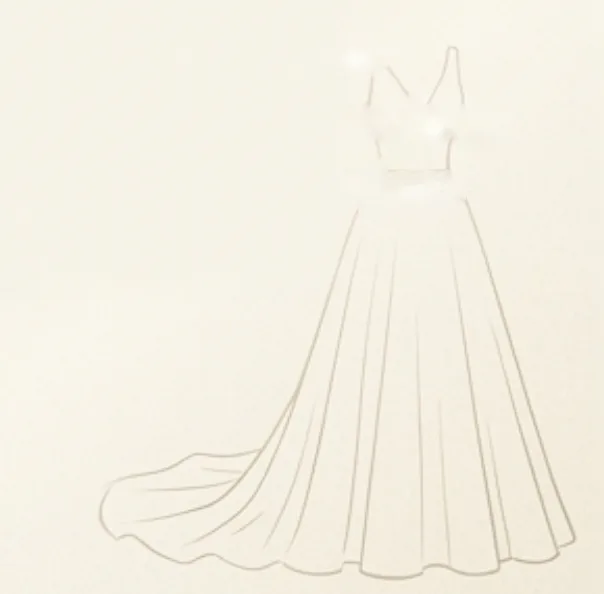 Sweep Train
Hemming & bustle at fitting
Sweep Train
Hemming & bustle at fitting
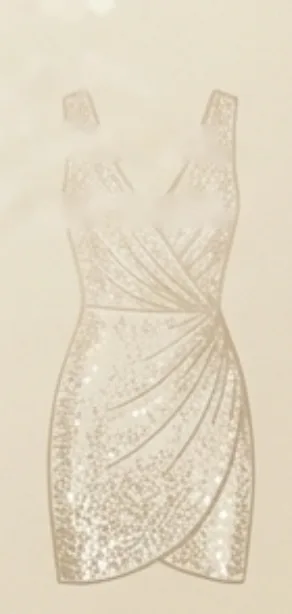 Fitted Sequin
Precision sizing matters
Fitted Sequin
Precision sizing matters
What You’ll Learn
Ten takeaways from Episode 01
Dresses Discussed in This Episode
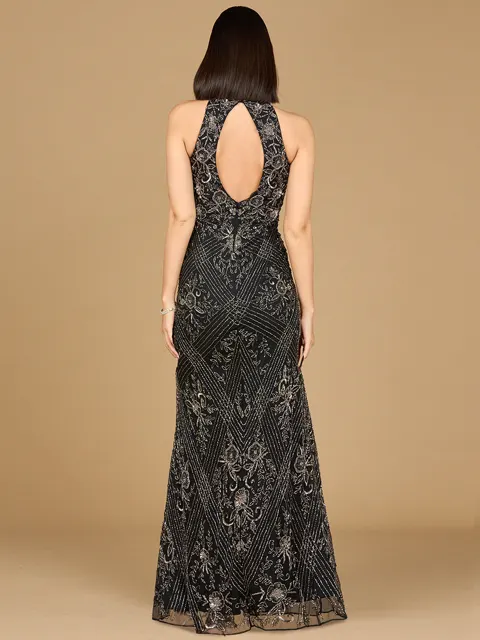
Halter Neck Beaded Dress
$550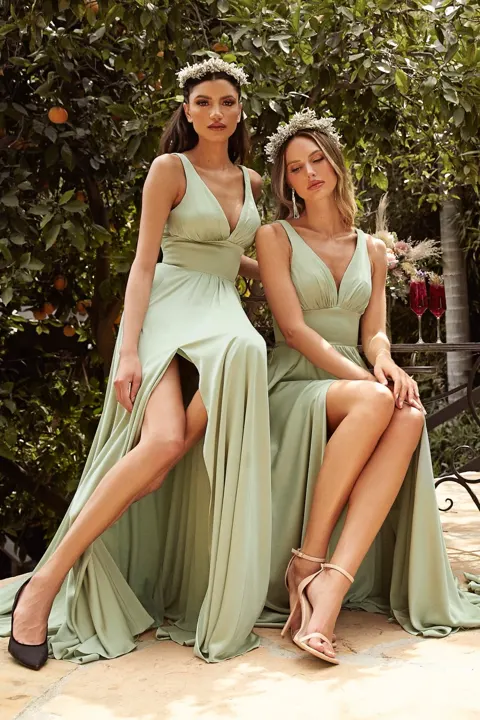
Ladivine 7469 Dress
$66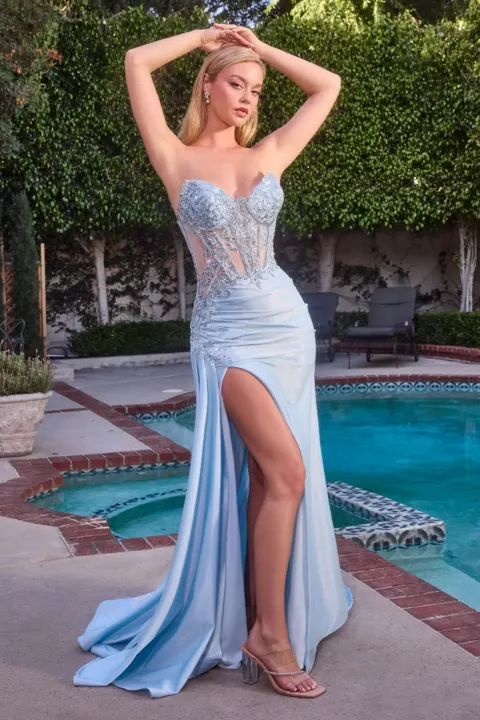
Ladivine CM369 Dress
$279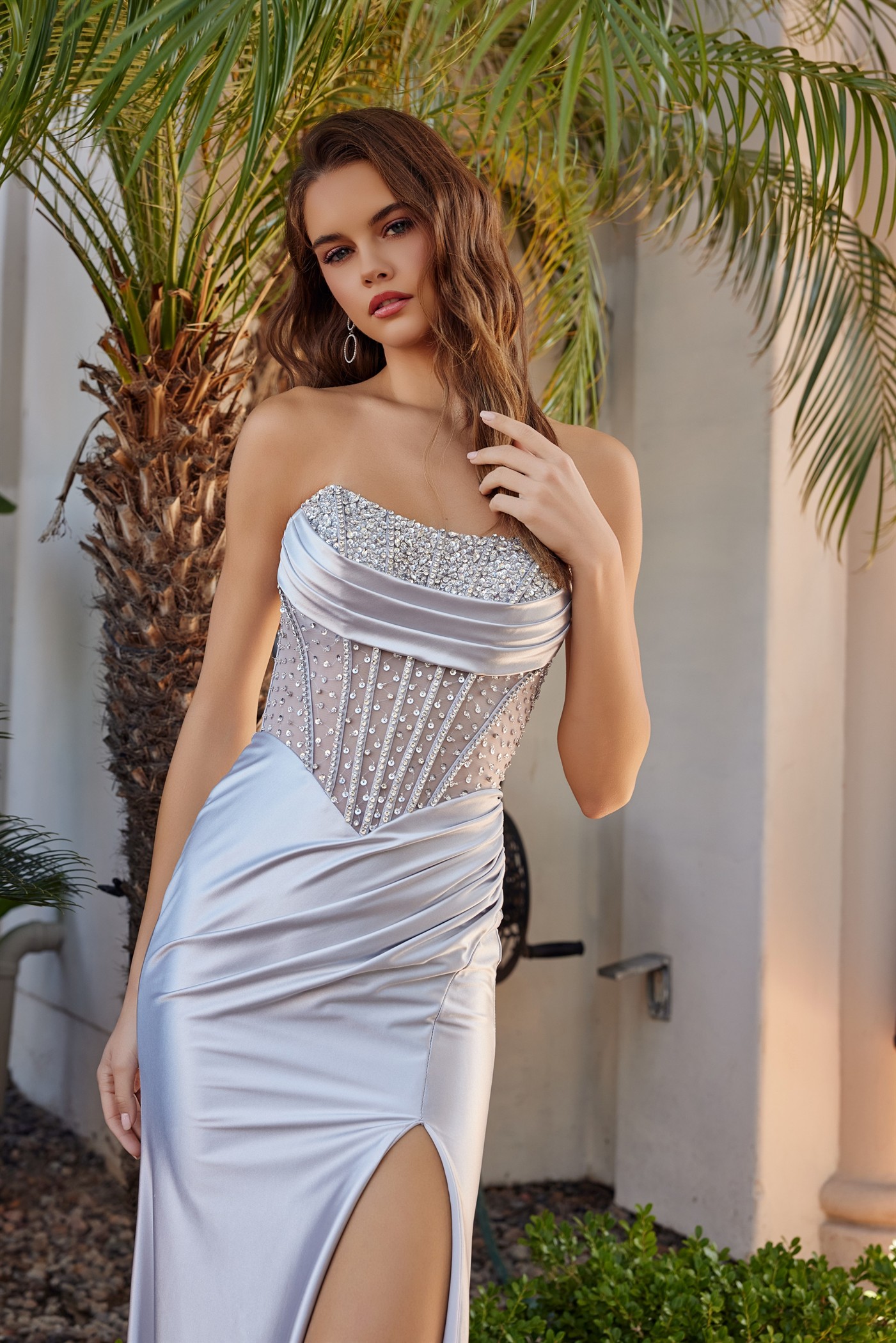
Fitted Rhinestone Embellished Bodice Thigh Slit Zipper Back
$301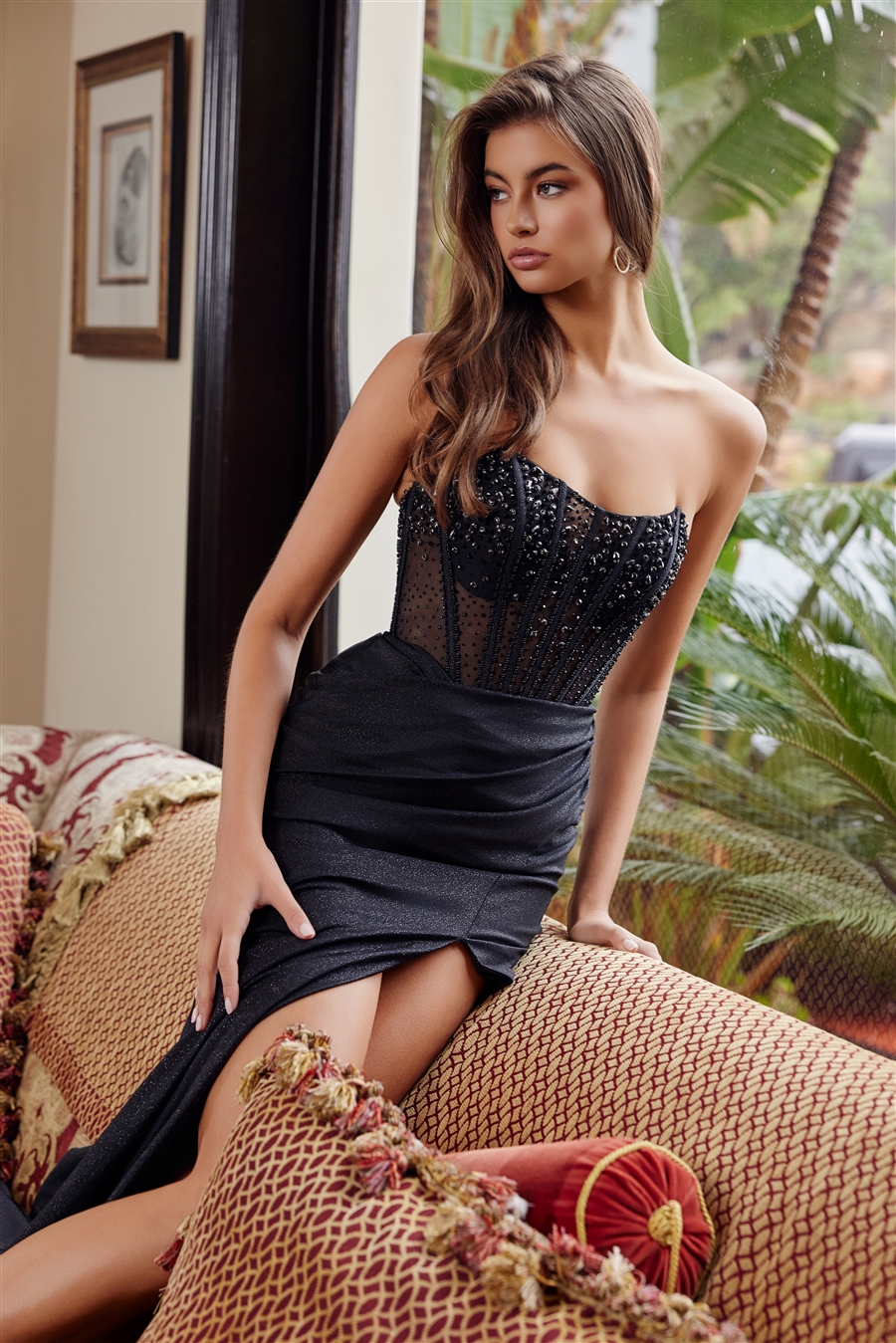
Strapless Beaded Neckline Boned Bodice Shimmer Stretch Satin
$283Prices and availability shown are current at page load and may have changed since the episode was recorded — each product page has the latest.
Full Episode Transcript
Episode 01 — Complete Transcript (32 min)
Opening: Don’t Throw Out the Manual
Host A: You know, usually when we talk about buying a really complex piece of furniture, there’s this expectation of a process.
Host B: Oh yeah, like building a Swedish bookshelf.
Host A: Exactly. You open that heavy cardboard box and you see a thousand different wooden pieces, and a bag of completely indistinguishable screws.
Host B: And that one tiny little Allen wrench.
Host A: It’s a logistical puzzle. But the saving grace is that there is always a manual. There’s a guided plan — a blueprint. And you might try to get it done without the manual. You might just start snapping things together, assuming you can just figure out the internal logic on the fly.
Host B: Which never works out well. There will probably be tears. You’ll definitely have extra dowels left over.
Host A: And the second you put any actual weight on that shelf, the entire thing just collapses — because the structural integrity is compromised from step one. You relied on assumptions rather than the actual instructions. But then you step into the world of formalwear, specifically the monumental, highly emotional task of shopping for a prom dress — and suddenly, people are perfectly willing to throw the manual right out the window.
Host B: It’s wild, isn’t it? People will spend weeks researching the specs on a new television, but they will drop hundreds of dollars on a structured gown relying entirely on the size tag on the hanger.
Host A: Which is a huge mistake — because the shocking reality is that the size tag is basically lying to you. The assumptions we make about everyday clothing just completely fall apart when applied to designer formalwear. It’s a completely different retail ecosystem. So today, we are unpacking the manual before the pressure is on.
Host B: Welcome to the deep dive. Today we’re navigating the logistical maze of preparing for Prom 2027 — taking you from feeling overwhelmed to feeling completely empowered, educated, ready to navigate this like a pro. And we are doing this by relying on a very specific foundational blueprint: Heather’s Prom 2027, the Preseason Guide.
Host A: The value of this specific guide is really grounded in reality. Every fact, every policy, every mechanical breakdown of a dress that we’re going to explore today is based on the actual operations of Heather’s Boutique — a physical retail store and alterations atelier in Oconomowoc, Wisconsin.
Host B: It’s anchored by Heather Rock, the founder and CEO, and her background is really what makes this so fascinating. She has over twenty years of experience as a master seamstress — so she isn’t just selling garments off a rack. She is engineering how they fit on a human body.
Host A: Her background as a tailor fundamentally shapes the entire philosophy of the boutique. She actually operates under this guiding belief that the store is a ministry of beauty. For her, fitting a dress is not a simple retail transaction — it’s about fitting dreams, milestones and memories. The ultimate goal is to help every person step into their beauty boldly and without apology.
Host B: Which is so important. You think about how a poorly fitted dress can completely ruin the memory of a night. If you’re constantly tugging at a bodice, or tripping over the hem, you aren’t feeling beautiful. You’re just distracted — uncomfortable all night.
Why Prom 2027 Planning Starts Now
Host A: So keeping that philosophy in mind: before we can even begin to talk about the glamour of the dresses — the tulle, the sequins, the silhouettes — we have to talk about the calendar. Because the very first question anyone asks when looking at a Prom 2027 guide in August of 2026 is, “Why are we talking about this now?”
Host B: It feels incredibly early. So why are we launching this deep dive so far in advance?
Host A: The formalwear supply chain operates on a timeline that just defies modern consumer expectations. We are so accustomed to the fast-fashion model, that two-day shipping ecosystem, that we assume a prom dress can be summoned on a whim. But if you look at Heather’s Boutique’s standard shipping timelines, standard shipping within the US takes an estimated four to nine business days.
Host B: Okay — four to nine days doesn’t sound too bad, right? If my prom is in May, my brain tells me I can just start looking online in mid-April.
Host A: And that right there is the trap. That four-to-nine-day estimate is exclusively for merchandise that is currently in stock. It only applies to physical items that are sitting on a shelf in Oconomowoc, already boxed up and literally just waiting to be handed to a carrier.
Host B: So what about everything else online?
Host A: The reality of designer formalwear is that a massive portion of the inventory you see online is what is known as designer fulfilled.
Host B: Let’s unpack that — designer fulfilled. Because if I’m on a website and I see a beautiful A-line gown labeled as orderable, I’m picturing a warehouse with my exact dress in my exact size and the exact color I want, just sitting in a bin waiting for me.
Host A: Which is a very dangerous assumption. An item labeled as orderable absolutely does not mean it is physically sitting on a rack waiting to be shipped to you tomorrow. In special-occasion apparel, the boutique is acting as an authorized retailer. Most designer merchandise is ordered by the boutique directly from the designer, in the season’s specific sizes and colors, on your behalf.
Host B: So you are essentially triggering a chain reaction when you click buy.
Host A: Exactly. You place the order with Heather’s Boutique. They process your request and transmit it to the designer’s warehouse — which might be in Los Angeles or New York. The designer processes the order on their end, packages it, ships it to the boutique — or sometimes drop-ships it to you — and only then does the final leg of the journey begin.
Host B: That adds so much time to the process. And then there’s the backorder variable.
Host A: Which completely bypasses any standard shipping estimate. For backordered or special-order items, the expected ship dates are incredibly dynamic — moving targets displayed on the specific product page, shifting based on when the designer’s next production run is scheduled to land at their domestic warehouse from their overseas manufacturers.
Host B: I can literally hear the collective groan of parents listening to this right now. I know the temptation is to say: this online logistics game is too stressful — why not just wait until March, walk into the store, and buy whatever is physically hanging on the rack?
Host A: Walking in during the spring is always an option — physical boutiques absolutely carry extensive seasonal inventory. But waiting removes the luxury of choice. When you delay until the last possible moment, you transition from shopping for the dress you actually want, in the color that complements you best, to simply shopping for whatever happens to be left in your general size category. You are forcing a reliance on luck rather than planning. You might find something okay — but the chances of finding the dream dress drastically plummet.
The Holistic Prom Budget
Host B: And beyond the timeline of the physical garment arriving, preseason planning is vital for the timeline of the budget. The guide introduces a concept that is often overlooked until it’s just too late: the holistic prom budget.
Host A: Which is a conversation that definitely needs to happen between parents and students before anyone falls in love with a six-hundred-dollar gown. Because the price tag on the dress is just the starting point — it’s not the final number. A holistic budget encompasses the gown, the highly specific undergarments required for the gown’s architecture, plus the shoes, the accessories, the event tickets, the dinner — and crucially, the custom alterations.
Host B: It really adds up fast.
Host A: If parents and students haven’t negotiated all of those elements in advance, the financial friction can completely overshadow the joy of the event. It really emphasizes that formalwear is not fast fashion. These are specialized garments produced in very specific seasonal runs. Treating them like a disposable next-day-delivery purchase is the root cause of most prom-season stress. Respect for the supply chain and the holistic budget is the foundation of a successful experience.
Why the Size Tag Is Lying to You
Host B: Okay — so assuming we respect the calendar, we have our budget, and we are looking at dresses online early. The very first thing a shopper tries to do is pick a size from the dropdown menu.
Host A: And here is where we hit the most disastrous pitfall in the entire process — the biggest mistake you can make: assuming your everyday street-clothing size translates to formalwear. It is a profound disconnect that ruins countless online purchases.
Host B: I think we really need to explore why that is. Why can’t I just order the size six that I wear in my favorite brand of jeans?
Host A: Everyday street clothing, especially in the American market, is heavily influenced by vanity sizing. Over the decades, brands have slowly increased the physical dimensions of a garment while keeping the number on the tag exactly the same — or even lowering the number just to make the consumer feel better. So a size six in a modern mall brand might actually have the physical dimensions of a size ten from twenty years ago. But formalwear often adheres to much older, traditional tailoring blocks. Plus, the fabric usually lacks the high percentage of spandex or elastane found in casual clothes.
Host B: So a formal dress doesn’t forgive you. It doesn’t stretch to accommodate a heavy lunch.
Host A: No, it does not. And it gets even more chaotic, because the sizing doesn’t just differ from street clothes — it differs drastically between the designers themselves. The boutique’s published Fit Guide is incredibly explicit about this. It states that it is crucial to utilize each specific designer’s size chart when purchasing. You cannot assume brand loyalty to a number.
Host B: Let’s pull some actual data from Heather’s catalog to prove how dangerous this assumption is. We have two major designers to look at: Dave & Johnny, based out of New York, and Nox Anabel, based out of Los Angeles. Let’s look at the actual measurements for a size six in both brands.
Host A: For a Dave & Johnny size six, the designer’s chart maps that specific size to a thirty-five-inch bust, a twenty-nine-inch waist and a thirty-nine-inch hip.
Host B: Now I switch tabs on the website. I fall in love with a Nox Anabel gown. I figure — hey, I’m a six in Dave & Johnny, I must be a six here.
Host A: But if you order a Nox Anabel size six, their chart dictates a thirty-five-inch bust, a twenty-seven-inch waist and a thirty-eight-inch hip.
Host B: Wait — a twenty-seven-inch waist? Compared to a twenty-nine-inch waist — that is a full two-inch difference in the waist measurement for the exact same size label.
Host A: The physical implication of a two-inch deficit in a structured bodice is massive. Two inches in the waist is the difference between a dress zipping up beautifully and a dress not closing at all — or potentially breaking the zipper if you try to force it. If we connect this to the bigger picture, it proves that the size tag on a formal dress is essentially an arbitrary symbol.
Host B: It’s like international currency exchange rates. A six in one country holds a completely different purchasing power than a six in another. If you hold American dollars and walk into a store in London, you don’t just hand them a twenty-dollar bill and assume it covers a twenty-pound item. You have to check the exchange rate.
Host A: The designer size chart is your exchange rate. You literally cannot guess. The tag tells you nothing — the chart tells you everything.
How to Measure: Bust, Waist and Hips
Host B: So since the size tag is effectively useless without its corresponding chart, the only way forward is to rely on our own cold, hard data. We need to know our exact measurements. But taking accurate measurements seems like one of those things that sounds simple until you actually try to do it.
Host A: According to Heather’s Fit Guide, navigating these designer charts requires three specific metrics — the big three: the bust, the waist and the hips. Taking these accurately dictates the success of the entire ordering process. The guide breaks down exactly where to put the tape measure: for the bust, measuring over the fullest part; for the waist, around the natural waistline; and for the hips, measuring around the fullest part — which they note is approximately eight inches below the waist.
Host B: But there is a golden rule repeated for all three.
Host A: Yes — the directive is: keep the measuring tape comfortably loose.
Host B: I have to admit, my initial instinct pushes back on that a little bit. If I am buying a fitted, structured dress and I want that contoured look, shouldn’t I pull the tape measure as tight as possible to get the smallest possible number?
Host A: I see why you’d think that, but that instinct ignores the mechanics of human movement. A mannequin stands perfectly still in a window display — but a human being has to breathe. The ribcage physically expands and contracts with every breath. Plus, you have to sit down in a chair at a table, which naturally redistributes body mass around the waist and hips. You have to get in and out of a car. You’re going to be dancing. A dress measured to the absolute tightest tolerance might look incredible for the one minute you are standing perfectly straight for a photo — but it becomes a torture device for the remaining five hours of the night. The comfortably-loose rule ensures the garment has the necessary ease to accommodate your body in motion, not just your body at rest.
Host B: It ties right back to Heather’s philosophy of feeling wonderful rather than restricted.
Host A: Now, the guide also tackles the physical act of measuring with a very practical piece of advice: it strongly recommends using a measuring buddy, usually a parent or a friend.
Host B: But why the insistence on a buddy? Can’t someone just stand in front of a full-length mirror and do it themselves?
Host A: The geometry of the body actually changes the moment you try to measure yourself. If you wrap the tape around your waist, you naturally have to bend your neck and hunch your shoulders to look down at the numbers. And the moment you twist your torso to read the tape on your hips, you alter the shape of your body — you compress one side and stretch the other, immediately skewing the data.
Host B: Wow — so you introduce user error just by trying to observe the measurement.
Host A: Exactly. Standing perfectly straight with your arms relaxed at your sides, looking forward, while a measuring buddy handles the tape and records the numbers — that’s really the only way to ensure the data is untainted by posture shifts.
Host B: So let’s say you do it perfectly. You and your buddy get the three numbers, comfortably loose, and you cross-reference the designer’s chart — but what happens when the numbers don’t perfectly align? Say your bust maps to a size eight on the chart, but your waist falls into the size ten category.
Host A: The boutique anticipates this scenario, and they provide explicit guidance: do not guess. The instinct is often to just split the difference or blindly size up or down based on a hunch. The directive is to contact the boutique directly — call the Oconomowoc store, provide your specific measurements and the specific dress model you are analyzing, and rely on their professional sizing guidance.
Host B: That is such a vital safety net — because not all three measurements carry the exact same weight for every single dress. The importance of the bust, waist or hip measurement entirely depends on the architecture of the gown.
Silhouettes: Fitted vs. A-Line
Host A: The intersection of design and data is where this gets truly fascinating. We have to analyze the silhouette, the structure and the closures to understand how to apply our measurements. So let’s contrast two primary silhouettes using real examples from the boutique’s catalog. First, the fitted gown. There is a stunning piece — the Lara New York 28891. It’s a sleeveless, halter-neck, beaded tulle dress with an open back, priced around $550.
Host B: Beautiful dress.
Host A: A fitted gown like that Lara New York model is engineered to contour the natural lines of the body — from the bust down through the waist and continuing tightly through the hips and thighs. Because it hugs the lower body, matching your hip measurement to the size chart is of paramount importance.
Host B: Because if the dress doesn’t have enough room in the hips, what happens?
Host A: It will ride up constantly as you walk, or the fabric will bunch uncomfortably around the waist — or, under the tension of sitting down, the seams could potentially tear. You must accommodate the widest part of the body that the dress is designed to closely cover.
Host B: Okay, but then you look at an A-line silhouette. Let’s look at the Ladivine 7469 — a soft satin gown in sage, on sale for $66, actually.
Host A: Great price — but the architecture is entirely different. An A-line gown is fitted through the bodice and then flares outward from the natural waistline, creating the triangular shape of the letter A. Because the skirt flows away from the lower body and does not contour the legs or hips, the hip measurement drops significantly in importance.
Host B: So you could have hips that measure a size twelve, but if the A-line dress fits your size-eight waist and bust, the hips don’t matter.
Host A: Exactly — because the skirt is essentially a wide canopy. For that Ladivine A-line, the critical focus shifts entirely to ensuring the bust and the waist measurements match the chart accurately, because that is the only portion of the dress engineered to sit flush against the skin.
Closures: Corset Backs vs. Zipper Backs
Host B: So the silhouette dictates which measurement is the boss. But the closure mechanism — how the dress physically fastens onto your body — dictates your margin of error. This is a huge point. The guide dives into corset backs versus zipper backs, and the difference is night and day.
Host A: The closure is arguably the most critical structural element of the bodice. A corset back utilizes a lace-up tie system, weaving through loops or grommets down the back of the dress. A great visual for this is the Ladivine CM369 — a strapless stretch taffeta fitted gown. It has this intricate sheer lace bodice, but the back is a full lace-up corset. The engineering brilliance of a corset is that it allows for micro-adjustments directly on the body. You can pull the tension tight across the bust to prevent slipping, perhaps leave a little more room through the middle ribs for breathing comfort, and then cinch it tightly again at the natural waist to anchor the garment. It provides customized snugness.
Host B: I think of a corset back like a pair of high-end lace-up sneakers. Throughout the day your foot naturally swells, or maybe you wear a slightly thicker sock — it doesn’t matter, because you just adjust the laces. The shoe adapts to you.
Host A: A corset closure offers a structural grace period. It can absorb minor measurement variations.
Host B: But then you contrast that with a central zipper back. Look at the Nox Anabel A1745, which features a fitted rhinestone bodice, or the Nox Anabel A1739, a shimmer stretch satin gown with a boned bodice. Both of those rely heavily on a zipper.
Host A: And a zipper provides a flawless, streamlined, modern finish — but it is entirely unforgiving. If a corset is a lace-up sneaker, a zipper back is a tailored leather riding boot. It either zips up entirely or it doesn’t. What’s fascinating here is that the closure literally dictates the margin of error. A zipper demands strict, uncompromising adherence to the designer’s size chart. The teeth of the zipper must meet perfectly without excessive tension — there’s zero structural grace built into the mechanism. If your waist is even an inch larger than the chart indicates for a zipper-back dress, you will not be able to close the garment. And if you force it, you risk derailing the zipper completely or tearing the delicate surrounding fabric.
Host B: Which would be a disaster. It really emphasizes why the measuring phase has to be taken seriously — it’s the most important step.
Online Returns, Final Sale and Wardrobing
Host A: You factor in the A-line versus fitted silhouette, you account for the strictness of a zipper versus the forgiveness of a corset, and you finally feel confident enough to click Order. You’ve done the work. But the logistical journey doesn’t end when the box arrives on your doorstep. We have to talk about the post-purchase reality: online buying and returns.
Host B: The online return policy outlined in Heather’s preseason guide is a vital piece of education regarding standard industry practices for formalwear — because it differs vastly from everyday e-commerce.
Host A: The policy is incredibly clear. There is a strict seven-calendar-day return request window, and that clock starts ticking from the date of confirmed delivery — not business days. If it arrives on a Friday afternoon, Saturday and Sunday count against your seven days. Furthermore, standard returns are subject to a ten percent restocking fee, and the customer is responsible for the return shipping costs.
Host B: I have to play devil’s advocate here on behalf of every online shopper accustomed to massive online retailers. A seven-day window, a restocking fee, plus paying for my own return shipping — that feels incredibly brutal compared to buying a T-shirt online where I have thirty days and a prepaid return label just sitting in the bag.
Host A: It absolutely feels restrictive if you’re comparing it to casual apparel. But understanding the why behind the policy changes the perspective completely. Special-occasion wear is highly fragile. We are talking about garments constructed with intricate beadwork that can catch and pull, delicate layers of sheer tulle that snag easily, and structured internal boning that can warp if handled improperly. They aren’t designed to be shoved into a poly mailer bag, shipped across the country, tried on by ten different people, and shipped back over and over again. The formalwear season itself is also incredibly short and concentrated. But the primary driver for these strict policies is to prevent a retail phenomenon known as wardrobing.
Host B: Wardrobing — meaning someone buys the dress, tucks the tags carefully inside, wears it to the prom on Saturday, and then tries to return it on Monday claiming it didn’t fit. They are essentially treating the boutique like a free rental service.
Host A: A tight seven-day window and a ten percent restocking fee act as a strong deterrent against that behavior. Ultimately, this policy isn’t just about protecting the boutique — it is a consumer-protection mechanism for the next buyer. It ensures that when you order a dress, you are receiving a pristine, untouched, brand-new garment that hasn’t been sweat in at a party.
Host B: It puts the responsibility on the shopper to get the measurements right the first time. It highlights why the previous steps are so vital.
Host A: Now, there are also critical exceptions to the return policy that the guide highlights — the final-sale reality. Any online items explicitly marked final sale, which typically encompasses clearance or outlet items, cannot be returned under any circumstances. Additionally, all in-store purchases made at the physical Oconomowoc location are strictly final sale.
Host B: That makes perfect sense to me. The online return policy exists solely because you cannot physically interact with the dress before buying. If you are in the store, that barrier is removed. You have the opportunity to touch the fabric, inspect the beadwork, try it on, and consult directly with the styling staff. You’re making a fully informed physical purchase — so the sale is final.
Alterations: Crafting the Final Fit
Host A: So once the dress arrives, you try it on, the fit is generally correct based on the size chart, and the return window closes. You’re keeping the dress. But it is crucial to realize that it is still not truly your dress yet. The final phase of the preseason guide leads us into the alteration atelier — crafting the final fit.
Host B: This might be the most misunderstood phase of the entire formalwear experience.
Host A: The guide makes it absolutely clear: alterations are a paid professional service. They are never automatically included with the purchase of a dress — whether you buy it at Heather’s Boutique or any other formalwear retailer. You are essentially hiring a highly specialized artisan to re-engineer a mass-produced garment to the specific, unique topography of your body. It requires significant skill and time.
Host B: And at Heather’s, this process is structured around the fitting appointment — a private, one-on-one session. For prom, they allocate a forty-five-minute prom first fitting, and the guide explicitly notes how they handle urgent timelines.
Host A: If you wait until two weeks before the event to book an alteration, the boutique does not automatically accept the job. Urgent timelines require a personal review by Heather to assess if the complex tailoring can physically be executed in time without compromising quality.
Host B: It reinforces the overarching theme of the whole guide: respect the calendar.
Host A: Now, when you do secure that fitting appointment, there are strict instructions regarding what you must bring into the fitting room. We can call it the holy trinity of the fitting room. Number one is obvious — you have to bring the actual dress. But numbers two and three are where people get tripped up. Number two: you must bring the exact shoes, or the exact heel height, that you are planning to wear for the event. And number three: the exact undergarments intended for the event.
Host B: The insistence on the exact shoes is rooted in the structural physics of the human body. People assume they can just wear sneakers to the fitting if the seamstress is only pinning the hem. The thought process is: I know my heels are three inches tall — just pin the dress three inches off the floor. Why doesn’t that work?
Host A: Because stepping into a three-inch heel does not merely elevate you three inches vertically. The heel fundamentally changes your geometry. It physically changes the tilt of your pelvis. It alters the curvature of your spine. It shifts your center of gravity backward — which inherently changes the posture of your shoulders, the thrust of your chest, and the arch of your back.
Host B: So the shoes don’t just dictate where the hem falls on the floor — they completely alter how the bodice of the dress drapes across your torso.
Host A: If Heather pins the hem while you’re standing flat-footed in sneakers, and then you wear heels to the prom, the dress will be entirely too short. But not only that — the bodice may pull or gap in unexpected ways, because your posture is radically different. And the same logic applies to undergarments. If she tailors the bodice while you are wearing a standard sports bra, and then you wear a structured push-up bustier to the event, the bodice will no longer fit correctly. The exact shoes and undergarments are non-negotiable, because they dictate the final architecture of the dress on your body.
Host B: And because of all these complex variables — the layers of tulle, the intricate beadwork that must be removed and reapplied, the boning, the zippers — we have to look at the budgeting and pricing for this artisanal stage.
Host A: Because Heather custom-tailors each gown based on its unique construction and your unique body measurements, pricing is only determined after an in-person physical inspection of the garment on your body. The guide is firm that there are no instant quotes over the phone. You can’t just call up and say, “Hey, how much to hem a prom dress?” — because hemming a single-layer unlined satin skirt takes a fraction of the time and skill required to hem a skirt consisting of five layers of tulle, plus a crinoline slip, plus a horsehair-braided hemline adorned with lace appliques. The seamstress must see the engineering of the dress to understand the labor required to alter it.
Host B: This loops perfectly back to the beginning of our discussion. It means the price tag on the dress is only part one of the financial equation. Parents and students have to actively reserve a portion of their holistic budget for the artisan who makes the dress fit perfectly.
Host A: The dress you buy online is essentially the raw material. The alteration is the final polish. A masterfully altered gown is the difference between wearing a dress and a dress wearing you. The alteration is the magic that makes the garment truly yours.
Recap and Closing Thought
Host B: This entire journey through the preseason guide completely shifts the perspective on prom shopping. We started by dissecting the reality of shipping logistics — understanding that designer-fulfilled and backordered items mean we absolutely cannot treat formalwear like next-day fast fashion.
Host A: We dismantled the myth of the size tag, using hard data to prove that sizing is arbitrary between designers — making the specific size chart the only reliable source of truth.
Host B: We explored the physical mechanics of taking accurate measurements: why we must keep that tape comfortably loose to accommodate breathing and movement, and why relying on a measuring buddy prevents the skewed data caused by twisting your own spine.
Host A: We analyzed how the structural architecture of the dress — the hip forgiveness of an A-line versus the contour of a fitted silhouette, the micro-adjustments of a corset back versus the strictness of a zipper — changes how we interpret those measurements.
Host B: We also navigated the strict realities of online return policies — recognizing that a short return window and restocking fees are actually consumer protections designed to preserve the fragility and pristine condition of these garments against wardrobing.
Host A: And finally, we explored the vital necessity of the alteration atelier — understanding the physics of why the holy trinity of dress, shoes and undergarments must be present to ensure the final fit is flawless. Through all of this, the guide implicitly reminds us that preparing for prom is a collaborative project. It requires a parent–student partnership: the parents manage the logistics, the timeline, the holistic budget and the tape measure, while the student leads the creative vision — the style, the expression, and ultimately the joy of the choice.
Host B: Which brings me to a final thought I want to leave everyone with today. We live in a world absolutely dominated by instant-click fast fashion, where garments are treated as disposable — cheap, and bought without a second thought regarding how they are made. I wonder if this process we just described — the slow, deliberate, highly personalized journey of formalwear shopping — could actually be an incredible teaching moment. The act of standing still and being measured with a physical tape, of studying a designer’s size chart instead of just grabbing a medium off a rack, of understanding garment architecture like corsets and zippers, and finally visiting a local seamstress for custom alterations to adapt the fabric to your specific body. Could this actually be one of the best educational experiences a teenager can have to truly understand the value, the craft and the structural reality of the clothes they wear?
Host A: It forces a profound respect for the garment, doesn’t it? The complexity of tailoring, the skill of the artisans. It replaces that disposable mindset with an appreciation for lasting quality.
Host B: So before the pressure is on and the calendar runs out, maybe it’s time to stop throwing the manual out the window.
Host A: I agree completely. Embrace the logistics, respect the process, and you’ll be setting the stage for a truly flawless Prom 2027.

Heather’s Expert Perspective
Everything discussed in this episode is grounded in the working reality of Heather’s Boutique in Oconomowoc, Wisconsin. Heather brings more than twenty years of hands-on alteration expertise as a master seamstress — fittings at the boutique are private, one-on-one appointments, and alterations are a paid professional service quoted only after the garment is inspected in person, on your body, with your event shoes and undergarments.
The sizing guidance in the episode follows the boutique’s published Fit Guide: measure bust, waist and hips with the tape comfortably loose, and always check the specific designer’s size chart before ordering. When measurements land between sizes, the boutique’s advice is simple — don’t guess; contact the store.
Book a Fitting